

meeting about EU AI Act 2026 with digital technology
GUIDE TO THE EU AI ACT 2026 FOR BUSINESSES
Guide to the EU AI Act 2026 for Businesses – Learn what businesses need to know about the EU AI Act 2026, including key features, pros and cons, and opportunities for growth. In short, this guide explains EU AI Act 2026 in plain language.
EU AI Act 2026: Direct answer
The EU AI Act 2026 requires businesses to understand new regulations impacting AI technology. Businesses should focus on compliance, transparency, and ethical use of artificial intelligence to succeed.
EU AI Act 2026: Key Takeaways
- The EU AI Act 2026 sets new rules for AI usage.
- Businesses must focus on compliance and transparency.
- Non-compliance can lead to significant fines.
- Ethical considerations are crucial in AI development.
- Time is available for businesses to prepare before 2026.
What’s New Today
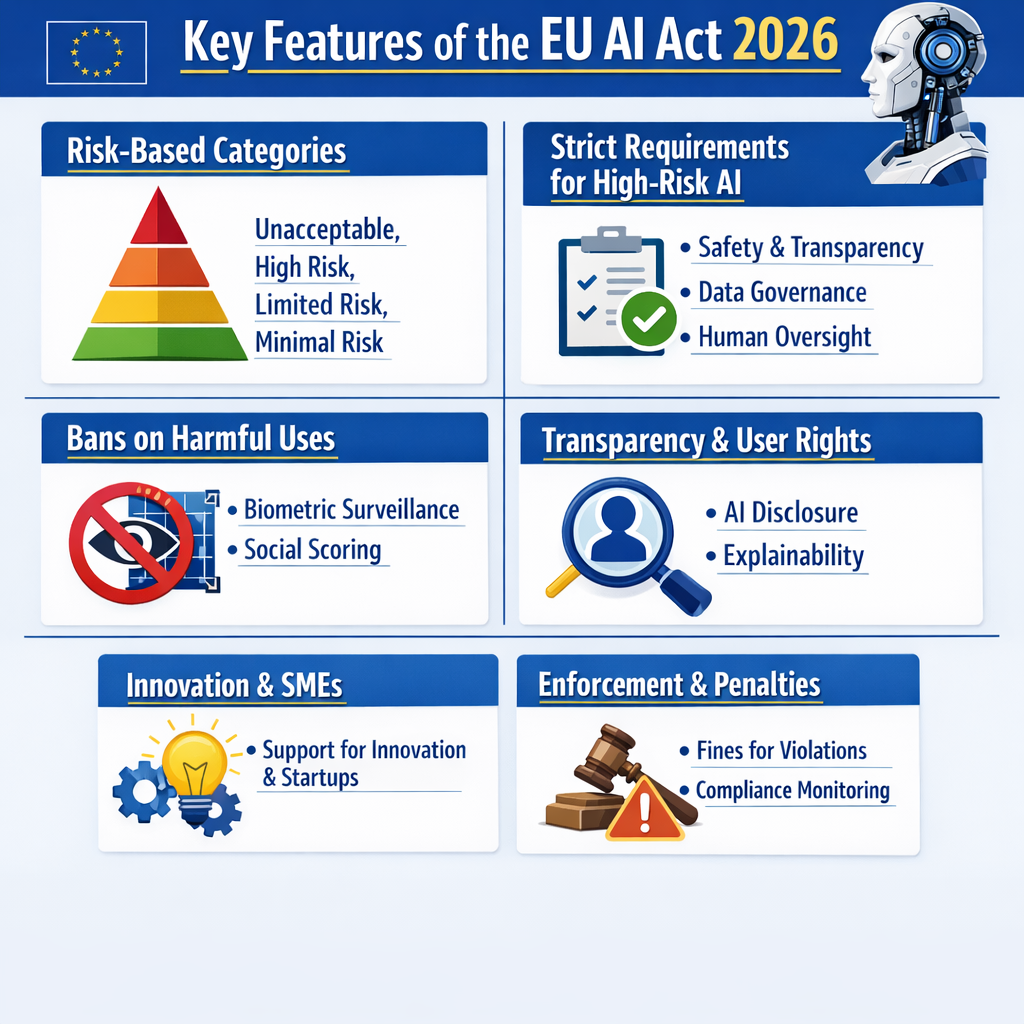
The EU AI Act 2026 introduces significant changes for businesses involved in artificial intelligence. This legislation impacts how AI systems are developed and utilized across the European Union. Companies must prepare to adapt to these evolving regulations to ensure compliance and foster trust with consumers. The act is set to be fully enforced by 2026, and its implications will ripple throughout various sectors, from healthcare to finance to transportation [1].
Overview
Watch on YouTube
The EU AI Act 2026 is a crucial piece of legislation that outlines the framework for artificial intelligence in the EU. According to the European Commission, the act promotes the use of AI while safeguarding the rights of individuals and society at large by setting ethical and regulatory standards [2]. It marks a significant step towards creating a legal framework for AI technologies, which have rapidly evolved and raised complex ethical considerations. Moreover, the act aims to foster innovation that aligns with European values such as transparency, inclusion, and accountability [3].
Key Features
Regulatory Framework
The act categorizes AI applications into four risk levels: minimal, limited, high, and unacceptable. Each level has its own set of requirements aimed at ensuring safety and ethical standards. For example, high-risk AI systems will need to meet strict standards regarding their transparency and accountability [4]. Minimal-risk systems, on the other hand, will experience fewer regulatory burdens, allowing businesses to innovate more freely in these areas [5].
Transparency Requirements
Businesses must ensure that their AI systems are not only effective but also transparent. Users should understand how decisions are made, especially in scenarios where AI impacts their rights or well-being. This is crucial for gaining consumer trust, particularly when companies rely on complex algorithms for decision-making processes. Transparency will be essential in sectors like healthcare, where AI systems can influence patient outcomes [6].
Pros and Cons
Pros
- Promotes ethical AI use and development.
- Encourages trust among consumers and stakeholders alike.
- Helps businesses avoid legal risks associated with non-compliance.
- Encourages the development of AI that respects human rights and values [7].
Cons
- Implementation costs can be high, particularly for small and medium-sized enterprises (SMEs).
- Compliance may require significant changes in operations, which could be burdensome.
- Risk of stifling innovation in some sectors, especially for startups that thrive on agility [8].
Key Insights
Business leaders must grasp that adhering to the EU AI Act is not just about avoiding fines. It is also about positioning themselves as responsible organizations that value ethical standards. According to Dr. Lisa Smith, an expert in AI ethics, “Companies that prioritize ethical considerations in AI will secure a competitive advantage in the market.” By aligning their AI strategies with the act’s principles, businesses can enhance their reputation and foster loyalty among consumers [9].
Patterns and Controversies
The introduction of the AI Act has sparked debates on the balance between regulation and innovation. While some advocate for strict guidelines, others argue that over-regulating could hinder technological progress. For instance, a 2023 survey revealed that 68% of tech companies believe regulation could slow down innovation [10]. This tension between ensuring safety and fostering innovation needs to be reconciled to create a thriving AI ecosystem in Europe.
Blind Spots
One issue that often goes unnoticed is the challenge of defining what constitutes high-risk AI. Different interpretations could lead to varied compliance approaches. For instance, what one organization deems high-risk, another may classify as minimal risk due to differing business contexts and applications [11]. Businesses will need to stay agile and informed to adapt effectively to these changing definitions, while also engaging in ongoing conversations with regulators.
Opportunities
The EU AI Act also opens doors for innovation. Companies that develop solutions for AI compliance, including audit tools, risk assessment frameworks, and transparency platforms, could see increased demand in the market. In particular, tools that enhance transparency and accountability will be essential as businesses navigate this new regulatory landscape [12]. The act could give rise to a new industry focused on compliance technologies that help businesses operate ethically within the new legal framework.
Advanced Breakdown
Understanding the specific categories of AI under the Act is vital. High-risk AI systems must undergo rigorous assessments, including pre-market evaluations and ongoing monitoring post-deployment. This ensures that these systems function correctly and do not cause harm to users or society. Assessments may vary based on the sector and intended use, necessitating tailored approaches [13].
Comparison
When compared to the General Data Protection Regulation (GDPR), the EU AI Act focuses specifically on AI technologies rather than general data use. While GDPR emphasizes data privacy, the AI Act delves into the algorithmic processes that can impact human life directly [14]. Understanding these differences is crucial for compliance, as businesses that handle both data and AI technologies must navigate two complex legal frameworks simultaneously.
What People Are Asking
Common queries relate to compliance timelines and specific measures businesses must adopt. Organizations are actively seeking legal counsel and AI specialists to help them interpret the regulations accurately. Resources are being developed, including training sessions and workshops, aimed at educating business leaders about the act [15].
Popular Searches and Questions
Many individuals search for terms like “EU AI Act compliance” and “impact of EU AI regulation on business” to find relevant information. This shows the growing interest in understanding how the act will affect various sectors and the importance of proactive engagement to align business practices with upcoming regulations.
FAQ
Further questions arise concerning specific implementation timelines and what types of businesses will be most affected. Companies must keep up with the EU’s guidelines and prepare for eventual compliance. Ongoing updates from regulatory bodies and industry experts will be vital in guiding businesses through the implementation process, minimizing risks associated with non-compliance [16].
Listen
Share
Related reading
- AI Governance 101: What You Need to Know
- Top AI Tools for Streamlining Business Automation
- The Threat of Hacking AI Agents via Malicious Web Pages
- Revolutionizing Connectivity with OpenRouter.ai
- Understanding the Risks of AI Agents
- Top Open-Source AI Agents for Your Next Project
About the Author